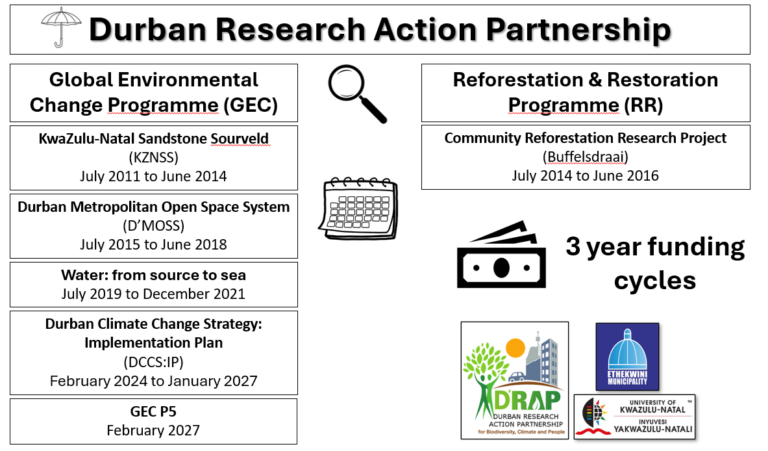
The
Durban Research Action Partnership (D’RAP) is a partnership between the
University of KwaZulu-Natal (UKZN) and eThekwini Municipality (EM) and is set
up as an umbrella under which various transdisciplinary research programmes,
such as biodiversity conservation, management and social-ecological systems,
are implemented. Through D’RAP, transdisciplinary research is conducted within
focussed research programmes within the eThekwini Municipal area in a range of
disciplines including environmental science, biological science, social
science, governance and economics. These research programmes aim to generate
much-needed evidence-based knowledge to assist eThekwini Municipality (both
municipal officials and leadership) in making informed and appropriate
environmental management decisions, and to build capacity by supporting student
research activities at the University. Such novel institutional partnerships
are important for generating knowledge and learning so as to address the gap
between scientific research, policy development and management within a local
government.